Amber sorting, bag folding, bead stringing at home: what is behind the ads
On this page · 8
“Work at home folding” is searched for about 170 times a month in Lithuania, “amber sorting work at home” – about 140, “bag folding” – about 110, “bead stringing” – about 50. All these ads promise the same thing: simple manual work at your own table and pay per unit. And all of them rest on the same scheme, only with a different prop.
In this part of the guide we look at each type of ad separately: what it promises, why such work does not pay for a company, where the hook is hidden. At the end – what a real handicraft order looks like and how to earn from manual work without intermediaries.
In short
- Amber is sorted and processed in workshops, bags and boxes are folded by machines, cheap bead jewellery is made by factories – distributing this work around homes does not pay for a company.
- The hook is the same everywhere: a deposit for “valuable raw material”, a fee for a kit of materials, delivery or an instruction.
- A real client has company details, signs a contract, provides the materials itself and takes nothing from you.
- If you are good with your hands, a more realistic route is to sell your own products yourself.
Amber sorting at home
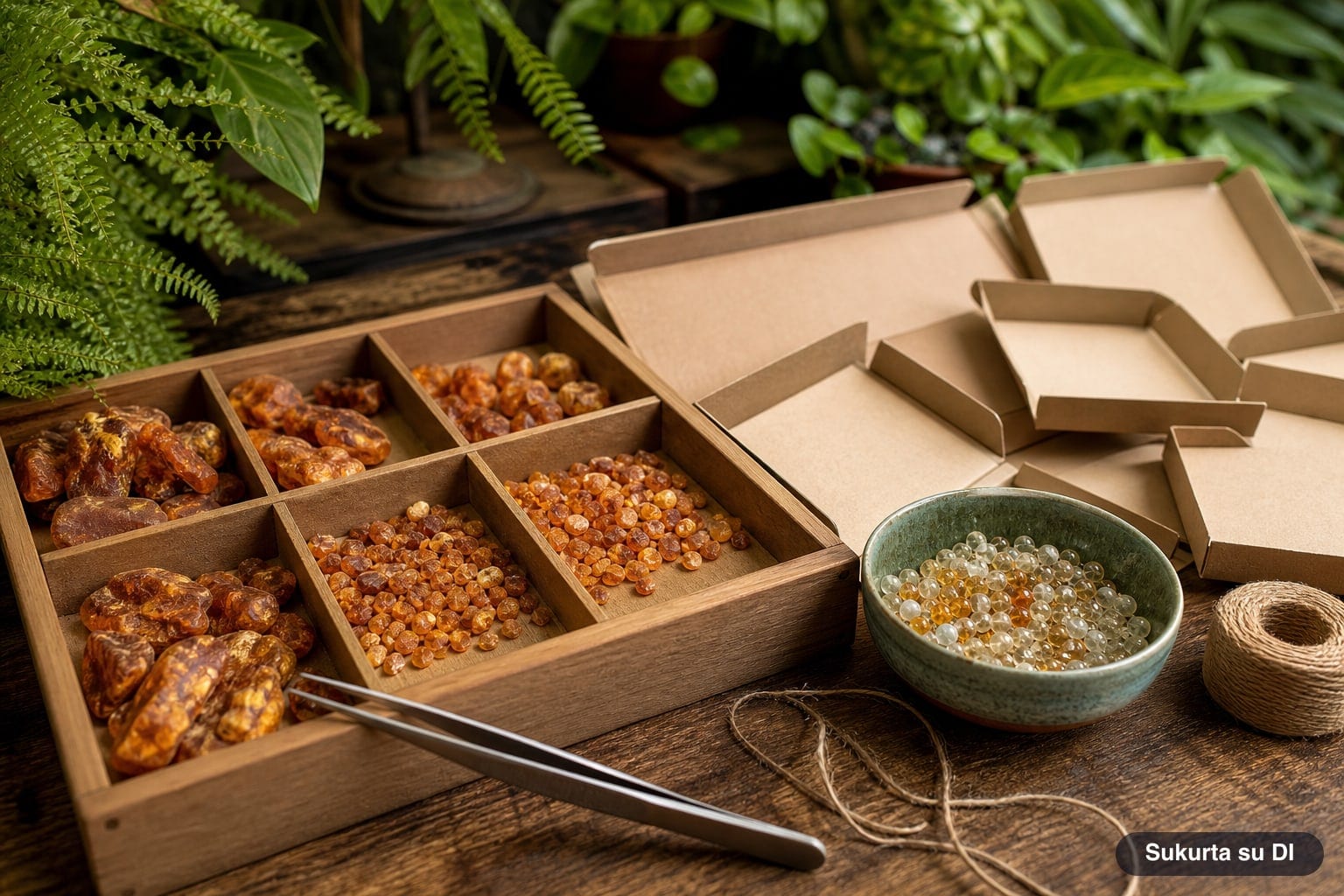
What the ad promises. You are sent a bag of amber pieces, which you have to sort by size, colour or shape and send back. You are paid per kilogram.
Why it is implausible. Raw amber is expensive and counted in grams, so nobody sends it by post to a stranger without a contract and insurance. Sorting in a workshop takes little time, because it is done by the same person who then processes the raw material and knows what they are looking for. Separating this step and distributing it around homes would mean more costs and more risk.
The hook. It is precisely the value of the raw material that is turned into a pretext: “since amber is expensive, we ask for a deposit”. Once the deposit is paid, the shipment does not arrive. Another version: you are sent a bag of worthless chips, and the sorted batch “does not meet the requirements”, so there is neither pay nor the deposit.
Folding bags, envelopes and boxes
What the ad promises. Paper bags, gift boxes or envelopes are delivered flat – you have to fold them, glue them and return them. Pay is per hundred or per thousand units.
Why it is implausible. Packaging is folded and glued by machines: it is one of the most automated stages of production. A folded box takes up many times more space than a flat one, so transporting finished boxes from homes back to the factory is the most expensive possible way to make them. Only very small, exclusive batches are folded by hand, and that is done at the printing house itself.
The hook. A fee for a “training kit” or an instruction, sometimes for delivery of the first batch. An older variety of this scheme is envelope gluing: the person who has paid receives only the advice to post the same kind of ad for others.
Bead stringing and jewellery making
What the ad promises. You are sent beads, thread and a sample; you have to string bracelets or necklaces. The company promises to buy everything you make.
Why it is implausible. Cheap mass-produced jewellery is made in factories, where the cost of one unit is counted in cents. Handmade jewellery sells for more precisely because it is created and sold under their own name by the maker – for them there is no sense in hiring strangers to string to a sample.
The hook. Here it is best disguised: you are asked not for a “fee” but to buy a kit of materials. It seems logical – after all, you receive an item. However, the price of the kit far exceeds its value, and the “buy-back” never happens: the products are declared to be of poor quality or the buyer disappears.
What all three have in common
| Ad | What is used as cover | What you are asked to pay for | What happens next |
|---|---|---|---|
| Amber sorting | The value of the raw material | A deposit | The shipment does not arrive or the work is “unsuitable” |
| Folding bags, boxes | Training | An instruction, the first batch, delivery | You receive only an instruction |
| Bead stringing | Materials | A kit | Nobody buys the products |
The table shows the most common variants described by people who have come across such ads; it is not official statistics.
A rule that fits all manual work ads
Money travels from the client to the worker, never the other way round. If you have to pay for or buy something before you start working, it is not a job but a sale to you.
What the police reports show
Police daily incident reports mostly describe larger cases, so there are no deposits of a few dozen euros for amber or bead kits among the cases we have collected. However, the mechanism is the same as in the most expensive schemes – first you are asked to transfer money. Below are the latest fraud cases from the reports.
What a real handicraft order looks like
Orders for manual work at home do exist – most often in sewing, knitting, crochet, leather or ceramics. They differ from the ads in several ways:
- The client is looking for a skill, not for “anyone”. They ask to see previous work or to make a paid trial piece.
- There are company details and a contract. A company name and code, a written agreement on quantity, price, deadlines and quality requirements.
- The materials are the client's. The client delivers them or pays for them; you do not buy them from the client.
- Payment is for the work done, within the agreed deadlines, to a bank account.
- The relationship is long-term. Usually these are small workshops or designers who need ongoing help, not a one-off mass ad.
If you work regularly and for several clients, it is self-employed activity that has to be registered. Which form suits you is explained in the ACS.lt article “Self-employment: registration certificate or business certificate”.
How to earn from manual work yourself
If you can string beads, knit or sew, you do not need an intermediary:
- Choose one product and make a few units – enough to photograph and show.
- Work out the price: materials, your time, packaging, shipping. If it comes to less than your hour is worth, the product is too cheap or too slow.
- Sell where the buyers already are: at fairs, in social media groups, on handicraft platforms.
- Register the activity when sales become regular.
It is a slower route than the ads promise, but on it the money moves in the right direction. And if manual work is not the goal but only a way to work from home, there are simpler options that require neither materials nor a warehouse.
Frequently asked questions
Is amber sorting at home a real job?
Ads that ask for a deposit for the raw material are a scam. Amber is sorted and processed in workshops, and nobody sends expensive raw material to strangers by post.
Can you earn by folding bags or boxes at home?
Packaging is folded by machines, so such orders practically never occur at home. If you are asked to pay for an instruction or the first batch, it is a scheme.
I bought a bead kit, and they do not buy the products. What should I do?
Save the ad, the correspondence and the payment confirmation, contact your bank and report it to the police via epolicija.lt or by phone on 112.
How do I tell a real handicraft client?
They have verifiable company details, sign a contract, supply the materials themselves and pay for the work done. You pay them nothing.
Sources
- Lietuvos bankas. Pakliuvau sukčiams: ką daryti?
https://www.lb.lt/lt/pakliuvau-sukciams-ka-daryti - Lietuvos policija. Paros įvykių suvestinės
https://policija.lrv.lt/lt/ivykiu-suvestines/
More articles
All articles