
Types of scams in Lithuania: how to recognise them and what to do if you fall victim
On this page · 7

In Lithuania people are most often deceived through SMS or emails with fake links, calls from someone posing as an officer or a bank, fake investment platforms and buying online. If you fall victim, first call your bank, then report to the police via epolicija.lt or by calling 112.
Scammers in Lithuania swindle people out of tens of thousands of euros every day – pensioners, students, business owners and accountants alike. The victims are not naive people: the schemes are designed to look convincing, and the decision has to be made in a hurry, when there is no time to think.
This guide is based on real cases from the police daily incident reports, which we collect every day in the Scam radar. Each of the most common schemes has its own article: how it works, how to recognise it and what to do if you have already transferred money or entered your details.
In short
- The most common schemes: an SMS or email with a fake link, a call from someone posing as an officer or a bank, a fake investment platform, fraud when buying or selling online.
- All of them share three things: pressure to hurry, a request to enter details or transfer money, and communication through a channel you cannot verify.
- If you fall victim, first call your bank, then report to the police via epolicija.lt or by calling 112.
Read in order or pick a topic
- 01
 Next chapterSMS scammers: a message about a fine or a parcel and fake websitesAn SMS about an unpaid fine, a held parcel or a blocked account and fake “e-police”, Regitra or bank websites: how to recognise them and what to do after entering your details.3 min read
 - 02
 Phone scammers: a fake police officer, bank or State Tax Inspectorate (VMI) employeePhone scammers in Lithuania: calls from someone posing as a police, bank or tax inspectorate employee, the “safe account” and the courier. How to recognise them and what to do.3 min read
 - 03
 Investment scammers: fake platforms, cryptocurrencies and “consultants”Investment scammers in Lithuania: how fake investment and cryptocurrency platforms work, how to check a company in the Bank of Lithuania's lists and where to report.3 min read
 - 04
 Scammers on classified ad portals: fraud when buying and selling onlineHow people are deceived when buying and selling online: an advance payment for non-existent goods, a fake courier and a link “to receive the money”. Real cases and how to protect yourself.3 min read
 - 05
 Forged invoice payment details: how scammers deceive companiesBusiness email compromise: a partner's forged invoice payment details, a fake instruction from the manager and an SMS to the company phone. How to protect the accounts department and what to do after paying.3 min read
 - 06
 Dating scammers: the romance scam onlineDating scammers: how the romance scam works on social networks and dating apps, what the warning signs are and how to help a loved one.3 min read
 - 07
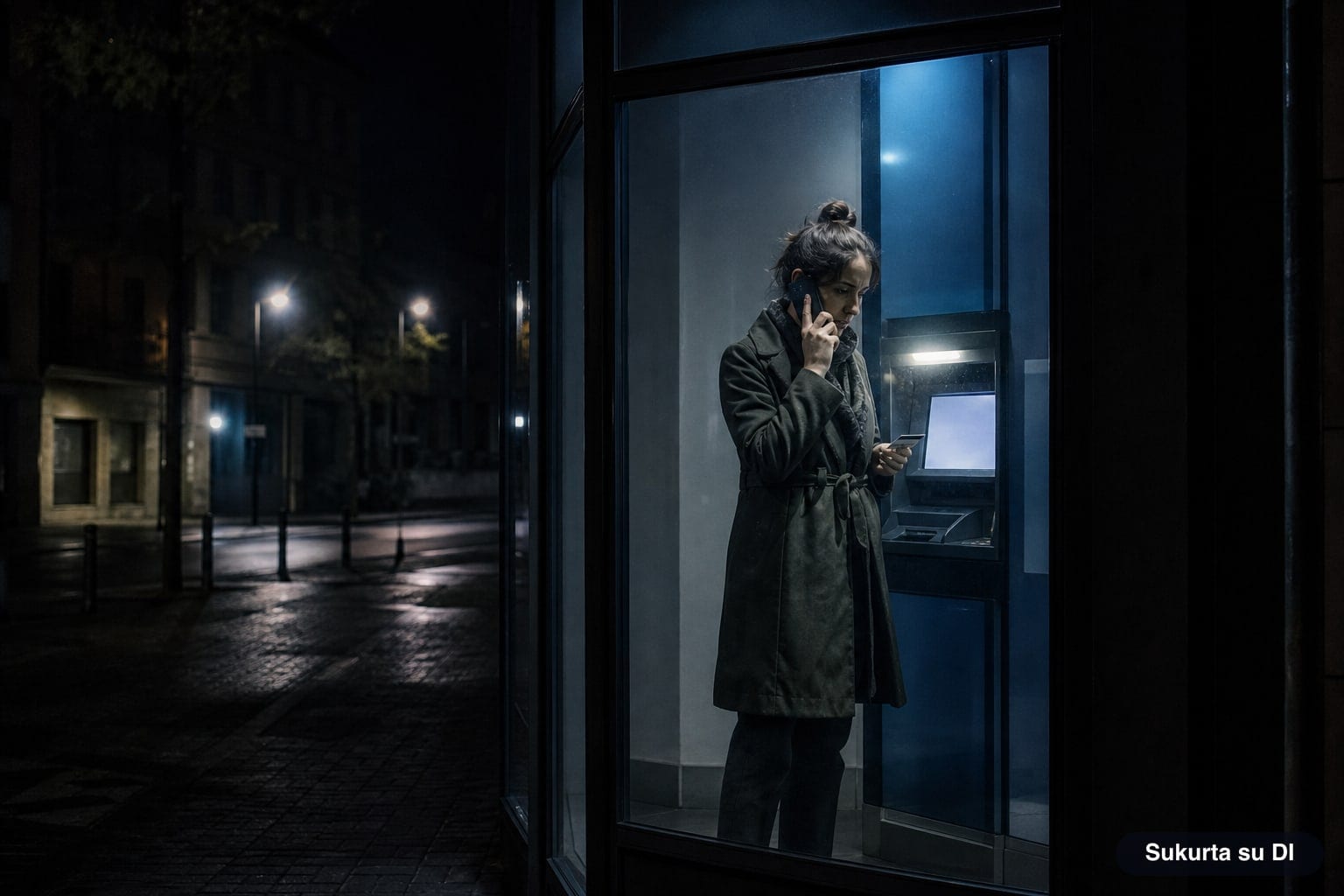 Scammed: what to do and where to turn, step by stepWhat to do if you transferred money to scammers or entered your details: the bank, the police, epolicija.lt, the Bank of Lithuania and NKSC. An action plan for the first hours and days.4 min read
How scammers choose a victim
They don't – they send thousands of messages and call thousands of numbers. In the police reports for the same week we see a young man born in 2005 who lost 1 650 € after an SMS about a fine, and a woman born in 1942 who handed over 10 000 € to a “tax inspectorate employee”. The scheme is picked according to who responds.
So the protection is not age or education but a habit: never make any decision about money or data during the same conversation or message.
Three signs that recur in every scheme
| Sign | What it looks like | What to do |
|---|---|---|
| Pressure to hurry | “The fine will increase”, “the account will be blocked”, “the offer is valid today” | Stop. A real institution gives you time |
| A request to act | Click a link, enter login details, confirm a Smart-ID code, transfer money to a “safe account” | Confirm nothing until you have contacted the institution yourself |
| An unverifiable channel | A call from an unknown number, an SMS with a link, a message via WhatsApp or Telegram | Call the official number that you find yourself |
The most common schemes in Lithuania
SMS, email or fake website
A message about an “unpaid fine”, a “held parcel” or a “blocked account” with a link to a website that looks like the real one. Once you enter your online banking details, the money disappears within a few minutes. This is currently the most common scheme in the police reports.
A call from someone posing as an officer or a bank
The caller introduces themselves as an employee of the police, a bank or the tax inspectorate and convinces you that the money needs to be “protected” – transferred or handed to a courier.
Fake investment platform
It starts with an advert or a form online. A “consultant” shows growing profit on a fake platform while the person transfers more and more. The sums in a single case run to tens of thousands of euros.
Buying or selling online
An advance payment for goods that do not exist, or a “buyer” who sends a link “to receive the money”. Sums range from a few hundred euros to almost 200 000 € for non-existent cars.
Forged invoice payment details
A company receives an email supposedly from a partner with a “changed” bank account. Once the invoice is paid, the money goes to the scammers.
Dating scam
Communication lasting several weeks or months, after which a “trouble” appears – and a request to lend money.
If it has already happened
Act immediately
- Cut off communication with the scammers – they will try to persuade you to transfer more.
- Call your bank – in some cases the payment can still be stopped. Block your card and change your passwords.
- Report to the police via epolicija.lt or by calling 112.
- If it is an investment scam – also report it to the Bank of Lithuania (Lietuvos bankas, LB).
For details, see the part of the guide on what to do if you have fallen victim to scammers.
Where to report an attempted scam
Even if you did not lose anything, report it: this helps block fake websites and numbers. The police state that scam websites, calls and messages can be reported to the National Cyber Security Centre (NKSC) by email at cert@nksc.lt or via the form at nksc.lt.
Frequently asked questions
Which types of scams are most common in Lithuania?
According to police daily incident reports – SMS or emails with fake links, calls from someone posing as an officer or a bank, fake investment platforms and fraud when buying or selling online.
What should I do if I transferred money to scammers?
Call your bank immediately – sometimes the payment can still be stopped. Then report to the police via epolicija.lt or by calling 112.
Can a bank or the police ask for login details over the phone?
No. Neither a bank nor the police ask you over the phone or by message to enter login details, confirm codes or transfer money to a “safe account”.
Where do I report a suspicious SMS or website?
To the National Cyber Security Centre (NKSC) by email at cert@nksc.lt or via the form at nksc.lt. If you have already fallen victim – to the police via epolicija.lt.
Is it possible to get back money transferred to scammers?
Sometimes – if the bank manages to stop the payment. That is why the most important thing is to contact the bank straight away, not the next day.
Sources
- Lietuvos bankas. Pakliuvau sukčiams: ką daryti?
https://www.lb.lt/lt/pakliuvau-sukciams-ka-daryti - Lietuvos policija. Pranešk apie bandymą sukčiauti!
https://policija.lrv.lt/lt/naujienos/pranesk-apie-sukciavima/ - Lietuvos policija. Paros įvykių suvestinės
https://policija.lrv.lt/lt/ivykiu-suvestines/ - Nacionalinis kibernetinio saugumo centras. Pranešti apie kibernetinį incidentą
https://www.nksc.lt/pranesti.html